Marketing Intelligence | Implementation Services

Salesforce Marketing Intelligence Services

Implementation & AI Activation

Unify cross-channel media, CRM pipeline, and campaign performance inside the Salesforce ecosystem, powered by Data Cloud, Agentforce, and embedded Tableau Next.

Unified marketing data Real-time campaign decisions Cross-channel clarity Faster time-to-value
Salesforce logo
Salesforce Select PartnerView our AppExchange page

Contact Us

Or reach us directly at: sales@decisionfoundry.com

The Marketing Data Challenge Enterprises face

Siloed data systems: Metrics scattered across platforms make comprehensive ROI analysis difficult.

Time consuming data management: Manual processes waste time and effort better spent on optimization.

Slow Insights: Delays in reporting can lead to inefficient spending and missed opportunities.

Inconsistent Data Models: Inaccurate naming conventions and mismatched conversion data leads to inaccurate reports.

One retail client came to us with 47 active connectors and no single owner for any of them. We've seen this pattern often enough that a connector audit is now included in Week one of every project.

Our Salesforce Marketing Intelligence Services

We deliver end-to-end consulting, data architecture, and implementation to make Salesforce Marketing Intelligence your single source of truth.

Data Foundation & Harmonization

We build a unified Marketing Intelligence data model using pre-built API connectors, TotalConnect frameworks, and automated taxonomy rules, aligning impressions, clicks, cost, and lead data across every paid, owned, and earned channel.

Salesforce Data Cloud Integration

We connect Salesforce MI natively with Data Cloud, bridging top-of-funnel ad engagement with downstream Sales Cloud and Service Cloud pipeline data. The result is full-funnel, multi-touch attribution from anonymous click to closed revenue.

Agentforce & AI Insights Activation

We deploy Agentforce AI agents that monitor campaign pacing continuously, flag budget anomalies via Slack or email, and execute approved optimizations automatically. Human-in-the-loop controls and audit trails are built in from day one.

Executive Dashboards via Embedded Tableau Next

Static PowerPoints get replaced with role-based Tableau Next dashboards for CMOs, media buyers, and channel managers, each updated in real time, each scoped to exactly what that person needs to see.

Managed Analytics & Governance

We establish data governance frameworks, taxonomy controls, and connector maintenance so your marketing intelligence setup scales as your media spend and channel mix grow.

What You Get

Customized implementation plans

Customized implementation plans

Pre-built data connectors and taxonomy libraries

Pre-built data connectors and taxonomy libraries

Harmonized data streams across campaigns, platforms, and geos

Harmonized data streams across campaigns, platforms, and geos

Business critical views of your data that drive decisions

Business critical views of your data that drive decisions

Adoption strategy to ensure ongoing platform value

Adoption strategy to ensure ongoing platform value

Need help unifying and harmonizing your data?

Our certified Salesforce architects build a unified marketing intelligence ecosystem tailored to your business model.

Talk to a Salesforce Marketing Intelligence expert today

Our 7-Week Implementation Process

Every Salesforce Marketing Intelligence deployment follows a structured methodology built for speed and durability, not plugged in and left to hope.

  1. Week 1

    Discovery & Taxonomy Mapping

    We audit your marketing tech stack, media channels, naming conventions, and conversion definitions. The output is a blueprint for your unified data model.

  2. Weeks 2 to 3

    Data Ingestion & Integration

    We build automated pipelines, map ad-platform connectors (Google Ads, Meta, TikTok, LinkedIn, GA4, and more), and connect Salesforce Data Cloud using zero-copy data sharing across cloud warehouses.

  3. Weeks 4 to 5

    Harmonization & AI Agent Setup

    We configure harmonization rules, custom KPIs, multi-touch attribution models, and Agentforce anomaly triggers calibrated to your business thresholds.

  4. Week 6

    Dashboard Build & User Testing

    We build Tableau Next dashboards, stress-test them over live campaign data, and validate attribution accuracy against CRM revenue records.

  5. Week 7+

    Deployment & Enablement

    We launch, train your internal teams, and establish ongoing governance workflows so the platform improves over time.

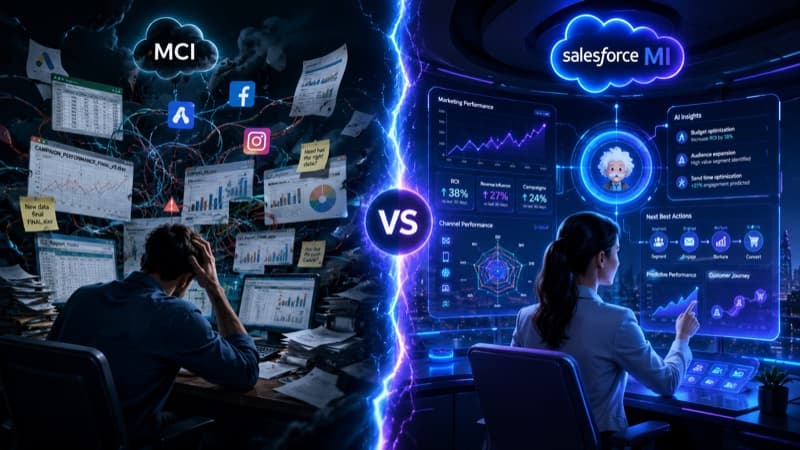
Salesforce MI vs. Legacy MCI (Datorama): What Has Changed?

Many enterprise organizations are transitioning from legacy Marketing Cloud Intelligence (MCI / Datorama) to modern Salesforce Marketing Intelligence (MI). Understanding the fundamental structural evolution helps teams maximize their technology investment:

Feature / ArchitectureLegacy MCI (Datorama)Salesforce Marketing Intelligence (MI)
Underlying ArchitectureStandalone SaaS database layerNatively built on Salesforce Data Cloud
Data SynchronizationScheduled batch data ingestionReal-time streaming & Zero-Copy Federation
Data Warehouse IntegrationRequires ETL or custom API pipelinesDirect, zero-copy integration with Snowflake, BigQuery, & Databricks
Analytics EngineNative MCI visualization widgetsEmbedded Tableau Next & Pulse insights
AI CapabilitiesEinstein automated insights & alertsAgentforce AI Agents for autonomous campaign optimization
Attribution ModelingIsolated media attributionFull-Funnel CRM Attribution (Anonymous click to closed revenue)

Real Questions from MI Buyers

Asked by teams evaluating Salesforce Marketing Intelligence, answered by our MI architects.

“Today we average several attribution models together. How would you build a custom, blended model in MI?”

What MI can do

MI supports standard attribution models: first touch, last touch, linear, time decay and U-shape for touch-based attribution, plus first and last touch for funnel-based attribution. You can view several models side by side to compare how each one credits your campaigns.

What MI can't do on its own

Averaging several models into one blended model isn’t a standard MI option. To maintain that approach, the blend would need to be calculated outside MI, for example, in Data 360 or your existing Snowflake setup, with the result then shown in MI. Alternatively, you can choose one standard model as your primary view and retain the others for comparison.

“Contacts often sign up for several lead magnets in a short time, which skews our funnels. Can MI use custom engagement signals to keep each person’s path clean?”

What MI can do

MI attribution can use custom engagement signals (touchpoints), allowing you to decide which interactions count as an attribution touch.

What MI can't do on its own

MI doesn’t have a built-in setting that merges several sign-ups within a short period into one touch. This cleanup would happen in Data 360 before the data reaches MI. For example, sign-ups within a defined window (such as seven days) could be grouped into one touchpoint. Clear lifecycle stage rules in the CRM can also prevent repeat sign-ups from pushing contacts back through funnel stages.

“We currently run attribution off a separate Snowflake dashboard. Could MI replace that, or would it sit alongside it?”

What MI can do

MI can take over attribution reporting and dashboards, becoming the main reporting view over time.

What MI can't do on its own

Connecting MI to Snowflake data goes through Data 360’s zero-copy integration, which reads data where it resides without requiring a new pipeline. This means Data 360 is also needed.

If the blended attribution logic remains in Snowflake, MI would sit alongside it rather than replace it. We’d recommend running both dashboards in parallel for about one reporting cycle, checking that the numbers match, and then deciding whether to retire the Snowflake dashboard.

“Can MI flag the weak parts of a campaign? Is the Paid Media Optimization Agent ready, or should we start with Goals?”

What MI can do

MI has two relevant features, both currently in beta:

Goals: Set KPI targets (such as cost per acquisition or sign-up volume) and track which campaigns are falling behind their targets. This is the closest match to the functionality they currently like in ActiveCampaign.

Paid Media Optimization Agent: Reviews Google, Meta and LinkedIn ad performance, recommends which ads to pause and can pause them directly.

What MI can't do on its own

Neither feature is generally available yet, and both operate under Salesforce’s beta terms. The agent also works directly in live ad accounts and requires additional Einstein and Data 360 credits.

We’d recommend leading with Goals and cross-channel dashboards, positioning the agent as a later step once reporting is in place.

“Our ad spend is mainly on Google and Meta. Can MI show one performance view across both, with ROAS, CPC and conversion rate for each platform?”

What MI can do

MI has dedicated Google Ads and Meta Ads connectors that feed into one shared data model. Both platforms can sit side by side in one dashboard with CPC, conversion rate and ROAS for each. MI also incorporates CRM data, allowing ROAS to be measured against closed revenue as well as each platform’s reported conversions.

Have Your Own Question About MI?

Tell us about your reporting and attribution setup, and our MI architects will walk you through it.

Ask Our MI Team

Why Move from Legacy MCI (Datorama) to Salesforce Marketing Intelligence?

If you're currently using Marketing Cloud Intelligence (Datorama), moving to Salesforce Marketing Intelligence offers three key benefits:

01

Lower Data Storage Costs

Legacy MCI uses its own database and has separate licensing costs based on data volume. Salesforce Marketing Intelligence works within Data Cloud, helping you reduce duplicate data storage and manage your data in one place.

02

Smarter Campaign Optimization with Agentforce

MCI helps you track campaign performance and spot problems. Salesforce Marketing Intelligence takes this further with Agentforce. AI agents can identify underperforming campaigns, recommend changes, and help automate tasks such as adjusting campaign goals and budgets.

03

Easier Access to Enterprise Data

Salesforce Marketing Intelligence uses Data Cloud's zero-copy capabilities to connect marketing data with platforms like Snowflake, Databricks, and Redshift. This lets you analyze marketing performance alongside other business data without having to copy everything into another system.

Why the migration matters, practically:

Legacy MCI runs on its own proprietary database with separate row licensing. Salesforce MI runs inside Data Cloud and that alone cuts double-storage costs, removing the overhead that comes with maintaining a disconnected system.

The shift from passive alerts to autonomous action is bigger than it sounds. MCI tells you something went wrong. Agentforce adjusts campaign goals, shifts budget away from underperforming channels, and does it within your approved guardrails, without waiting for someone to log in and notice.

And because Salesforce MI inherits Data Cloud's zero-copy architecture, your marketing data sits alongside your enterprise warehouse without moving a single row.

What job roles benefit from Marketing Intelligence Services?

CMOs and marketing leaders

CMOs and marketing leaders get spend, pipeline, and ROI in one place, without waiting for the monthly deck. That's the most immediate change most of them notice.

Media buyers

Media buyers get real-time pacing alerts and automated optimization so budget doesn't bleed overnight.

Analysts, RevOps and sales leadership

Analysts stop pulling CSVs. RevOps and sales leadership can finally see how marketing connects to revenue, not just clicks.

IT and data engineering

And IT and data engineering teams reduce connector maintenance, eliminate redundant pipelines, and work within a governed architecture instead of around it.

Why Decision Foundry for Salesforce Marketing Intelligence Services?

Salesforce Select Partner

Recognized for our expertise in Salesforce Data Cloud, Marketing Intelligence, Agentforce, and Tableau.

20+ Years of Experience

We have been building marketing analytics and data solutions for over two decades. We know that AI is only as reliable as the data behind it, which is why we focus on getting the data foundation right first.

85+ Certified Experts

Our team has extensive experience working with marketing agencies, global brands, and Fortune 500 companies.

1,000+ Data Projects Delivered

We have completed over 1,000 data projects across industries, with more than 300 connected data streams currently running in production.

Deep Understanding of Agency Needs

We understand the challenges agencies face when managing data for multiple clients, working with different attribution models, and creating reports across accounts.

AI Governance Built In

Every Agentforce agent we deploy includes safeguards such as kill switches, weekly audit logs, human approvals, and error handling. These controls are built into the solution from the beginning, not added later.

Transparent Licensing and Pricing

Salesforce Marketing Intelligence licenses are purchased directly from Salesforce. Our implementation, data engineering, and ongoing support services are priced separately based on your requirements and the complexity of your data environment.

Ready to Get More from Salesforce Marketing Intelligence?

Whether you're implementing Salesforce Marketing Intelligence for the first time, migrating from Datorama, or improving your existing setup, our experts can help you get it right.

Talk to Our Salesforce Experts

Frequently Asked Questions

What is Salesforce Marketing Intelligence?

Marketing Intelligence (MI) is Salesforce's new Data-Cloud-native analytics platform for marketing: the strategic successor (positioning-wise) to Marketing Cloud Intelligence for organizations going all-in on Data Cloud + Tableau Next + Agentforce. MI sits on top of unified customer data, automates insights via Agentic AI, and surfaces performance intelligence inside the Salesforce platform with no separate data layer to maintain.

How is Salesforce Marketing Intelligence (MI) different from legacy Datorama (MCI)?

Legacy MCI (Datorama) operates as a standalone SaaS database with fixed row limits. Modern Salesforce MI is built natively on Salesforce Data Cloud, allowing zero-copy integration with data warehouses (Snowflake/Databricks) and leveraging Agentforce AI for autonomous optimizations instead of static dashboards.

Does Salesforce Marketing Intelligence support all of our ad channels?

Salesforce MI natively connects to major ad networks (Google, Meta, LinkedIn, TikTok, GA4). For custom, programmatic, or niche platforms, Decision Foundry uses TotalConnect frameworks, custom APIs, and Data Cloud ingestion pipelines to ensure 100% of your media spend is covered.

What does Salesforce Marketing Intelligence cost, including Data Cloud dependencies?

Platform licensing typically starts around $3,000/month for base row volume, but total cost depends on your Data Cloud usage credits and Tableau seat requirements. Decision Foundry provides fixed-scope implementation services (typically 4 to 8 weeks) to ensure your data ingestion is optimized so you don't overpay for unnecessary consumption credits.

We already use Tableau and Snowflake. Why do we need Salesforce Marketing Intelligence?

While Tableau visualizes data and Snowflake stores it, neither tool automatically normalizes or harmonizes complex media data. Salesforce MI automates the tedious harmonization layer (reconciling mismatched ad placement names, currencies, and attribution windows) before pushing clean datasets into Tableau and Snowflake.

Do we have to migrate off Datorama/MCI immediately?

No immediate migration is required. Legacy MCI (Datorama) remains fully supported. However, organizations migrating to Salesforce MI unlock deeper Agentforce AI capabilities, full-funnel CRM revenue attribution, and lower data-storage costs in Data Cloud. We offer a Migration Feasibility Assessment to help you decide when a transition makes financial sense.